U is for Unraveling

unraveling

As we enter our seventies, it is easy to dwell on changes in our minds and bodies with a view toward the negatives. We may experience pain and loss as our bodies age and as our lifestyle as we knew it for so long is left behind.

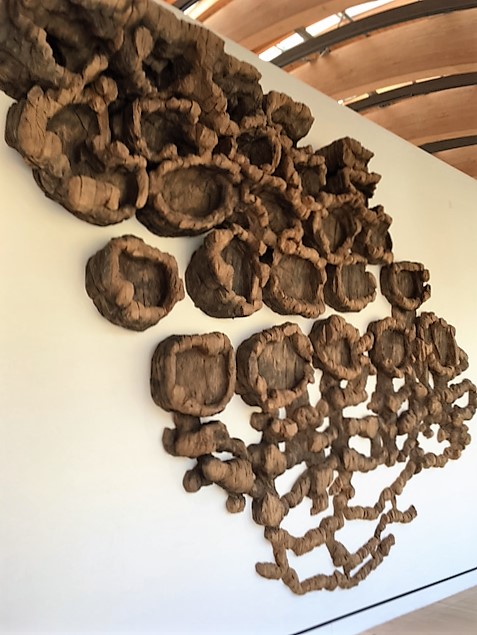
This photo of the work “Unraveling,” by Ursula Von Rydingsvard, is from a recent trip that a friend and I made to the Crystal Bridges Museum of American Art. The installation sparked my thinking about old age as an age of unraveling. There are two ways that I might choose to think about the verb, “to unravel.” The first is the negative connotation,    meaning at loose ends, or coming to pieces. That is the view of aging as one of pain and loss.

However, relying on my knowledge of Spanish and French, I choose the connotation of the words, desenlace, or denouement. These words literally mean untying or unknotting, and are used as literary terms for the resolution of the conflict in the plot of a literary word. In literature, the author unties all the twists and turns, knots if you will, of the plot to resolve the story, play, or book, thus leading to the conclusion. In our lives, our unraveling may be similar. What are some of the knots, the conflicts, that gifted elders experience that are waiting to be resolved in the final stage of our lives?

 Untying involves setting one’s agenda for the years (days/months?) that remain. Agenda-setting or goal-setting involves taking stock of our resources and proposing goals that respond to those realities. Thus, having surveyed my resources, I will never run a marathon, but I do intend to train as a marathon writer and to finish the three books that are in different stages of writing, to publish a book of poems, to read, to connect with loved ones, and to maintain my mobility during my final years. I will call on all the resources at hand to assist in untying and resolving those goals.  Surveying my fiscal resources, I will not spend them all at once on a world cruise. However, I do intend to travel each year, visiting familiar and unfamiliar places. As gifted elders we can plan a fulfilling agenda within the confines of our resources.

 Untying is setting our life in order in the sense that, in consideration of our loved ones, we simplify the process that they will need to go through after we pass. Do our loved ones know who to contact? Do they know where important papers are? Do the know what our wishes are?

 Untying involves saying what is left unsaid. For the past several years I have kept a gratitude journal, focused on family. Our youngest son who lives nearby knows where to find that journal to share with his brother and the rest of the family upon my demise. I have also begun final gifting, writing poems, notes, and other missives to family and friends and designating meaningful gifts from our belongings that will be significant to them.

Untying means resolving the inner tensions within ourselves  – letting go of past hurts and touching the mystery, the spiritual, in ourselves. Mindfulness, prayer, or other types of meditation become a daily ritual that assist us in unraveling. 

 What ties and knots do you have that need to be unraveled?

*Photo of “Unraveling” by Ursula von Ryndingsvard. In the collection of the Crystal Bridges Museum of American Art.


 This post is part of the Blogging from A to Z (2016)  Challenge. Click here. to see all of the blogs in the A to Z Challenge

 

T is for Tower

tower

Yesterday, I shared that I am traveling this week and that all the posts for this week were written before my departure. Because time is pressing in, this post is not as developed as I would like it to be. I share lines from the lyrics of a song by one of my favorite singer/composers, Leonard Cohen, interspersed with some connections I make to the lives of gifted elders. Enjoy!
                 Tower of Song
Well my friends are gone and my hair is grey
I ache in the places where I used to play
And I’m crazy for love but I’m not coming on
I’m just paying my rent every day
Oh in the Tower of Song…

I have lost four colleagues from my university since the beginning of this year. It is sobering to see role models like they were to me pass so suddenly. Extending the circle, my husband and I hear almost each week of lifetime friends who have passed. Each day is a gift, and a day to honor those we have lost. If you are a gifted elder, or if you have gifted elders as loved ones, my hope is that you will experience gratitude each day, no matter the aches or pains.

In the Tower of Song

I was born like this, I had no choice
I was born with the gift of a golden voice
My colleagues in the field of giftedness know what we risk when we use the “g” word. Many believe the term gifted is elitist. We cannot deny who we are. We were born like this. We had no choice. Among gifted adults and elders we find most of the same traits of gifted children, often with more intensity; for example, perfectionism, heightened empathy, curiosity, intense sensitivity, high energy, keen imagination.  Be gentle with yourself and with other gifted elders.

Now I bid you farewell, I don’t know when I’ll be back
There moving us tomorrow to that tower down the track
But you’ll be hearing from me baby, long after I’m gone
I’ll be speaking to you sweetly
From a window in the Tower of Song

Leonard Cohen is a writer who sees through so much of the deceit in the world. This is also true for most gifted elders. Embrace your new role as crone – a wise elder. We need the voices of elders in our world!

You can access the video of Cohen singing Tower of Song at: https://www.youtube.com/watch?v=WirxqAn7Ck8 .

Photo by Marleen Trommelen on Unsplash (https://goo.gl/L2SkEa).

This post is part of the Blogging from A to Z (2016)  Challenge. Click here. to see all of the blogs in the A to Z Challenge

S is for Satisfaction

satisfaction

S is for Satisfaction. I am satisfied. Thus far in April I have kept pace with the Blogging from A to Z Challenge. When this post becomes public, I will be visiting family. This post and all the posts for this week were completed by April 13, in order to appear on the designated days, despite the fact that I, as of April 22, will have been out of pocket for over a week.

I am satisfied.

Photo by Austin Schmid on Unsplash (https://goo.gl/rMgOPa)

This post is part of the Blogging from A to Z (2016)  Challenge. Click here. to see all of the blogs in the A to Z Challenge

R is for Resurrection

My husband’s mother and several of her siblings died with Alzheimer’s. This is a reality that is part of our world as we age. We are about the same age that she and others in her family were when they began to show symptoms of the advance of the disease. In the last few years my spouse’s memory has slipped. However, my own memory is not as sharp as it was even a few years ago. Often when we notice a lapse on his part, we used to look at each other with wide-eyed fear  – could he have it? Now, I stare it in the face and use humor as a weapon to quell the panic. We will make the best of it, no matter what comes along.

The following is a poem that I wrote a couple of years ago. It conveys my feelings that the act  of wrapping him in my arms reminds me of who he was, is, and shall be for me, always.

Resurrection

I remember watching small boys
Throw frogs against a wall,
Stun them, explaining
To me after that, as they
Enfold them in their hands,
They return to life.

Will you, if this dreaded disease
Is to stun and overtake you
And you become another,
If I embrace you, enfold you in my arms,
Encircle your face within my hands,
Will you come back to me?

JLN, 1/26/14
(Final revision 4.21.16)

This post is part of the Blogging from A to Z (2016)  Challenge. Click here. to see all of the blogs in the A to Z Challenge

Q is for Questions

question

Erik Erickson defined the stage of life in which elders find ourselves as Old Age and the conflict to be resolved at this stage was between integrity and despair. An integral part of the stage, in Erik’s views, is making a “life review” as a way of finding acceptance of one’s life in its completeness – to accept the good with the bad.

In this post, rather than a life review, I wish to present a live preview, posing questions that remain unanswered about what is to come. I offer these questions in order that those who are not yet elders will understand what their loved ones are questioning and contemplating.

  • When will I die? In other words, how many years, months, or days remain?
  • Between this day and the day that I die, will my memory be intact? What of my faculties will I lose?
  • How long will I be able to think clearly and manage my affairs?
  • Will I be able to communicate with my loved ones? How? Through voice, signing, writing?
  • Will I be able to care for myself?
  • How long will I be able to remain independent?
  • If I fall, how long will I have the strength to get up on my own, especially if I am alone?
  • Will I be strong enough to walk and to get myself to places that I need to be?
  • If I drive, how much longer will I be able?
  • Who will care for me if I need someone at home for a short time?
  • If I have to move to residential care, will I have a say in where I am placed?
  • Will I have enough money to sustain myself until the end?

If you are an elder, I offer this live preview in hopes that you will be able to use the questions, along with questions you generate to do some prior planning. If you have elders in the family, perhaps you will want to assist your loved ones in thinking about questions and making plans.

Q is for questions.

Photo by Evan Dennis on unsplash.com (https://goo.gl/nG3ddJ)

This post is part of the Blogging from A to Z (2016)  Challenge. Click here. to see all of the blogs in the A to Z Challenge
P is for Patience

old

Being an elder is an exercise in patience. I find I need patience with children like my grandson and other youngsters in our lives who are just beginning to learn and need for me and for other elders to give them the freedom to learn on their own. So often we see older people jumping in to finish a task when the little one is struggling to do so or, in the words of my grandmother, dawdling. I find patience is required in the marketplace as young adults are finding their way in the work world and may not yet have learned what old school customers expect. I find that patience is needed with middle-aged adults who are still in denial that they will ever be elders and sometimes criticize elders who have what seem to them to be curious habits. But most of all, I find that I must be patient with myself.

I remember my friend and mentor, Annemarie Roeper who, at 90 years of age, bemoaned the growing discrepancy between her mind and body. In Annemarie’s case it was so true! She was still writing and publishing in her early nineties and her thinking was as clear, as deep, and as well-deliberated as anyone I knew. I told her then that I understood her grieving the loss of her physical strength and abilities. However, as I age I understand much better what it is like to grieve the losses. In addition, I understand now what patience Annemarie developed. Now is my turn. 

Where do I need patience? I  need to learn to be patient when my perception goes awry and I must hold the handrail as I descend the stairs. I learn to be patient and to take the time make sure I lift my foot as high as the next step, rather than fall stepping onto the porch as I did a few days ago. I need to be patience as my hearing fades and I need to ask others patiently to repeat their words. When I plan to complete a project in a few hours and it takes me much longer, I need patience. When I need to memorize a set of concepts for a psychology exam and it takes many, many more rehearsals than even a few years previous, I need patience with myself. When my eyes tire much sooner at the computer than they did just a year ago, I need patience and need to manage screen time. When I forget, I need patience. When I tire quickly, I need patience. When I ache from arthritis, I need patience. And the list goes on…

Photo on unsplash.com by Christian Langballe (https://unsplash.com/photos/3I0X0owZS7M).

This post is part of the Blogging from A to Z (2016)  Challenge. Click here. to see all of the blogs in the A to Z Challenge


O is of OE’s

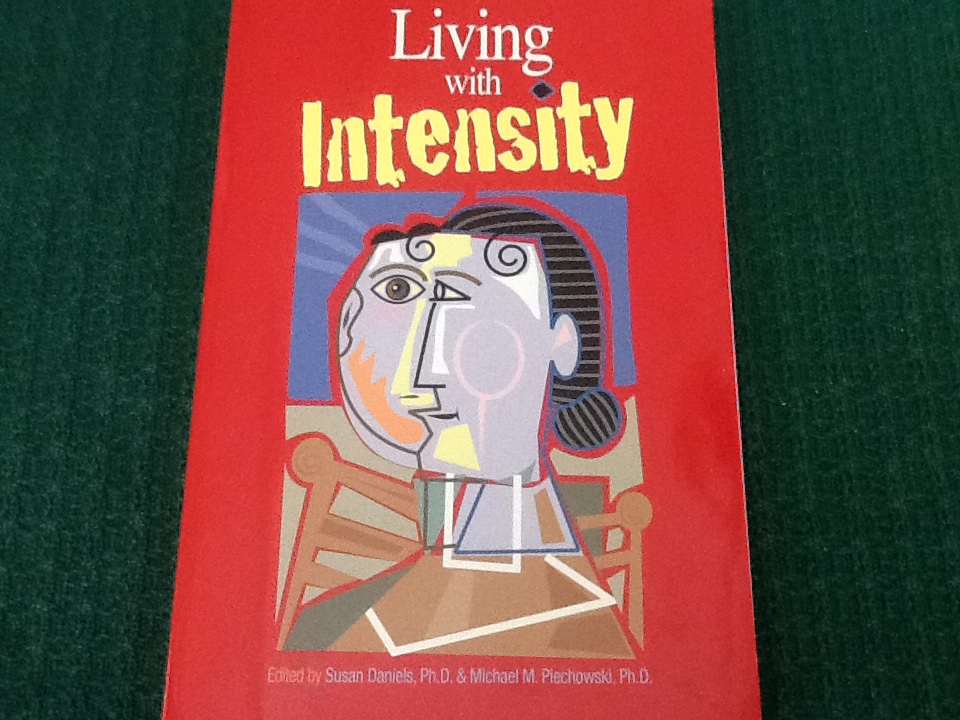
IMG_0211They Come Back! Overexcitabilities in Adults, was the title of a presentation that I delivered a number of years ago at different conferences on giftedness. Today, I am prepared to deliver a presentation entitled, They Come Back in Abundance: Overexcitabilities in Gifted Elders. Overexcitabilities (OE’s), or the term that I prefer, intensities, are the strong responses that many feel in the presence of certain stimuli in our environment. The construct of OE’s stems from the work of Dabrowski, a Polish psychiatrist who developed the Theory of Positive Disintegration. I reference below (and share a photo of) an excellent book in this regard for the reader who wants to learn more about Dabrowski, his theory, and OE’s. In this reflection I wish to share how intensities manifest themselves in some elders.

Psychomotor Overexcitability. This is the intensity that we see in gifted children who have an abundance of energy, talk almost constantly and very rapidly, and bubble with enthusiasm about a favorite activity, among other traits. In the gifted elder,  this intensity is seen as the need to be doing, producing, accomplishing something from early morning until bedtime. One does not just sit, one engages.

Sensual Overexcitability is heightened response from sights, sounds, tastes, textures, and smells. For gifted elders who experience this intensity, the world as we know it today can produce discomfort, pain, or pleasure (i.e., visual media are too loud or too graphic, tagless clothing is a blessing, fine art and/or music can produce inexplicable pleasure). For elders in residential care facilities, sensual overload may produce anxiety or depression.

Intellectual Overexcitability is the intensity we first think of in regards to gifted individuals. For the elderly, the rage to know – the intellectual imperative – and the desire to continue learning does not diminish. In some cases, especially with more time for learning in retirement,  elders need the opportunities to satisfy their love of learning.

Imaginational Overexcitability.  Elderhood for me is a time of imaginational richness. I dream every night and I remember my dreams vividly. They provide fodder for my creative production. As  with learning, the time freed up from not working fulltime allows for more poetry, more reading, and more creative activities in general. 

Emotional Overexcitability.  Intense emotional sensitivity never wanes, in my humble opinion. What I have noticed in my own life that changes is the self-acceptance to be able to feel an emotion deeply, no matter how deeply, and then to gently say to myself, “Ah! There it is. That is what I am feeling. I am grateful for both the negative and the positive feelings. They are gifts and I honor them.” That does not mean that one does not suffer loss, or pain, or other emotions. Rather, one recognizes one’s ability to feel emotions deeply and is at peace with it.

Dear Reader, this is just a brief overview of OE’s and there is much more to share. I hope to return to the topic in a future post. In the meantime, I suggest my friend Lisa Rivero’s blog, Write to Meaning. She has an excellent series about Dabrowski that she posted in November 2015.

Reference:

Daniels, S. & Piechowski, M. M. (2009). Living with intensity: Understanding the Sensitivity, Excitability, and Emotional Development of Gifted Children, Adolescents, and Adults. Scottsdale, AZ: Great Potential Press.

This post is part of the Blogging from A to Z (2016)  Challenge. Click here. to see all of the blogs in the A to Z Challenge

N is for Navan

9700430425_3c6a1b231d_kThe town of Navan is in County Meath, about an hour northwest of Dublin. Founded by Normans,  it is one of very few towns in the world whose name is a palindrome. The word itself probably originated in the Irish word, Uamhain, which means “cave.”

The surname Navan has a different origin. There are several alternate spellings of the name, among them are Naven, Nevin, and Navin. Navan may be a form of the Gaelic word, Naoimhin, which means, Little Saint, a term that was used often as at baptisms as a name of affection. I can never think about its meaning, Little Saint, without thinking about my father-in-law, who bore the surname and who was one – a little saint. A small man and Irish through and through, it is impossible to imagine that he ever had an enemy. Always quick with a smile and a kind word, we had a special bond because we were both readers. We shared ideas we came across and he seemed to delight in our conversations. I believe I was one of the few individuals in his life who shared his thirst for knowledge.

My father-in-law’s life had a great influence on how I interact with elders in my visits to residential facilities. As a boy and young man, he was fascinated with aviation, which was in its earlier years of development in pre-1920 years of his boyhood. He was so passionate about the field that as a young man, he built a scale model of the Spirit of St. Louis after Lindbergh’s flight. It was entered in a contest and consequently he won a college scholarship, which he had to turn down because his parents insisted he stay home to work the farm. 

How many of the gifted elders that we know and interact with had similar roadblocks in their lives? How many now are languishing in residential care, with no stimulation or opportunities to engage intellectually with peers that share their passions? What can we do as a society to differentiate care for our gifted elders?

Photo by Can Pac Swire on Flickr (https://goo.gl/xj32ku) (CC BY-NC 2.0).

This post is part of the Blogging from A to Z (2016)  Challenge. Click here. to see all of the blogs in the A to Z Challenge

M is for Mysticism


5900552416_20a67635c0_b

Let nothing disturb you,
Let nothing frighten you,
All things are passing away:
God never changes.
Patience obtains all things
Whoever has God lacks nothing;
God alone suffices.

— St. Teresa of Avila

My first acquaintance with mysticism was through reading works of the Spanish mystics, St. Teresa of Avila and St. John of the Cross. It was difficult for me to imagine someone praying so fervently that one would levitate as was reported of St. Teresa, or to think of a religious person performing self-mortification with whips or other instruments of torture in order to enter into a mystical trance like St. John of the Cross. How could a woman who seems to attain a consummate sense of tranquility in the prayer above plumb the depths of her soul to such an extent that she endured spiritual anguish and physical suffering? 

However, pain and anguish are not necessarily the primary characteristics of mystical experiences. Shrader, tracing the work of others (e.g., William James) and his own,  described seven characteristics, including:

  • ineffability, which is the inability to describe the experience with common, everyday language.
  • noetic quality, the feeling the individual has that mystical events reveal something to the individual or others which is otherwise unseen (such as the meaning of the Transfiguration of Christ for the disciples). 
  • transiency and passivity, two other characteristics, are echoed in the poem above by St. Teresa de Avila. 
  • unity of opposites, which is a sense of oneness of the universe. The poet William Blake captured this sensation in the following lines,

To see the world in a grain of sand
And heaven in a wild flower,
Hold infinity in the palm of your hand
And eternity in an hour.

  • timelessness, the feeling that the mystical experience is beyond time.
  • and a sense of encounter with the true self

In an article that I wrote for the SENGVine (2013), I referred to mystical events as those in which we touch the mystery. I shared that gifted individuals are preoccupied with existential questions like, “Who am I?” Where did I come from?” “What will become of me?” Often, those times when we touch the mystery are moments that – although they may be intense and often painful, they don’t answer our existential questions necessarily. Nevertheless, if we are fortunate, we are left with a sense of peace and well-being, similar to what is described in the words of St. Teresa that begin this reflection. One of the beauties of elderhood is that we can both relish the memories of our mystical experiences and use those memories to come to terms with who we are – our true selves.

Have you experienced moments of mysticism in your life? 

Reference:

Auden, W. H. and Pearson, N. H.  (Eds.). (1950). Poets of the English Language. New York, NY: Viking Press. Retrieved from http://www.poetryfoundation.org/poem/172906.

Navan, J.L. (2012, August). Touching the mystery: Spiritually gifted children. SENGVine. Retrieved from http://sengifted.org/archives/articles/touching-the-mystery-spiritually-gifted-children.

Shrader, D. W. (2008). Seven characteristics of mystical experiencesProceedings of the  6th Annual Hawaii International Conference on Arts and Humanities.

Photo by Hanna Grabowska on Flicker (https://goo.gl/JCV1FX) (CC BY-NC-ND 2.0).

 This post is part of the Blogging from A to Z (2016)  Challenge. Click here. to see all of the blogs in the A to Z Challenge

L is for Lexical, and Logomachia

739173692_70720e47f5_z

L is for Lexical

I am a lover of lexicon! Anything that has words awakens my hyperlexia, the good kind, my passion for reading. I believe that words must increase the uptake of serotonin in my brain, producing a natural high.

When I was two, my brothers came home from kindergarten with rhymes they learned at school. I used to hear them recite them once to my mother. Later, when my father came home from work, I would run to repeat them from memory to my father. Nursery rhymes, songs, stories, I loved them. In fact, in the introduction to a chapter in my book about gifted females, I used a personal narrative about myself.  For readers who saw this in a previous blog, forgive the repetition.

       Hailey discovered words the first time her mother read nursery rhymes and other poetry         to her. She imagined herself playing with the words – tossing them up in the air and                 watching them spiral, leap, and dance…She invented special gestures to accompany the           delightful sounds of her special words and shared them with all she met (Navan, 2009, p.         27).

As a preteen, I read through all the Nancy Drew and Hardy Boy books, moving on to Louisa May Alcott books. The custom of “reading through” or almost reading all the works of an author stuck with me – Hemingway, Steinbeck, Jane Austen, Willa Cather, Edith Wharton, and in adulthood Joyce Carol Oates, Annie Dillard, Maya Angelou, Toni Morrison, Barbara Kingsolver, and others. When I began studying Spanish language and literature, there was Garcia Lorca, Cela, Delibes, Matute, and more. I am happiest when there are words in front of me.

L is for Logomachia

The spark that began my reflection in this regard was a story I heard on NPR’s Morning Edition a few days ago. It was an interview with Ohio’s first Poet Laureate, Amit Majmudar. He is also a radiologist.  My favorite poems are those that leave me with the physical feeling of “ah” inside, even more so when they evoke not only the physical reaction in my chest that pushes outward on my ribcage, but also bring forth the verbal “AH!” from my lips. Majmudar is one of those poets.

In the interview the poet shared how he finds similarity between the mechanical work of a radiologist and composing poems. The two acts are similar for him in that both are a way of looking at patterns. Looking at an x-ray, he finds the pathology, the abnormality that disrupts the pattern. With his poetry, he delights in creating patterns with words. He said, “For me, it has this mathematical, musical aspect to it that quickens it into poetry.”  Below I share some lines from the Radiology section of his poem, Logomachia.

Each pixel: a point geometry
defines dimensionless, no height,
no width, no death. I see what ails the body

by regressing body back to spirit:
the volume a stack of planes, the plane a row
of lines, the lines a string of points,

and the point, at last, nothing at all, all form
substanceless by radiologic proof. I read
no images more imaginary than

the mind’s, every layer of it immaterial–
the gray matter,
the white matter,

the dark. (Majmudar, 2016, p. 76-77).

Yes, I am a lover of all things lexical! I imagine the worst punishment I could ever suffer might be to deprive me of the printed word. 

L is for lexical, and Logomachia.

References:

Majmudar, A. (2016). Dothead: Poems. New York, NY: Knopf.

Navan, J.L. (2009). Nurturing the Gifted Female: A Guide for Educators and Parents. Thousand Oaks, CA: Corwin Press.

NPR, Morning Edition. http://www.npr.org/2016/04/07/473238301/a-radiologist-and-poet-explains-how-he-sees-the-world-in-patterns

Photo by Pierre Metivier on Flicker (https://goo.gl/VfN1AB) (CC BY-NC 2.0).

This post is part of the Blogging from A to Z (2016)  Challenge. Click here. to see all of the blogs in the A to Z Challenge