K is for k unit vector, is for Kahn

6267107370_002f2c3e41_z

If Math anxiety is a diagnosable disorder, then I am the poster child. Just the thought of having to manipulate numbers to solve a problem brings on symptoms of a panic attack –  I feel my heart racing, I begin to glisten with perspiration, and my stomach begins to flip-flop.

It was not always so. In the 7th grade, the results of a standardized test showed my Math achievement to be equivalent to that of an 11th or 12th grader. Of course, imposter syndrome set in, preventing me from claiming that my success was due to my ability. I attributed it to luck. That was the last time I experienced any sense of pride in my mathematical ability.

Ninth grade Algebra was my downfall. Suddenly, we were replacing a known quantity such as the nine in (9 + 3 = ), for an unknown, and I needed much more scaffolding to understand algebraic concepts than my either inexperienced or inept instructor provided. In addition, the instructor – and I am sure the descriptor would be inept in this instance – left the room during our exams. Now, what could anyone expect of  a classroom full of 13 and 14 year-olds when given the opportunity to compare answers? Right, we cheated.  I can honestly say that was the only time that I participated in cheating. In my case and the case of others in the classroom, we did not actively ask for answers. Rather, when someone gave an answer to a problem that we had not yet solved, if that person was someone we looked up to, we merely wrote down the answer, doubting that we were as smart as the one who finished it first. I received a “B” in the class and knew in my heart that I did not have above average ability in Algebra. After that year I bought into the myth that girls could not do Math.

The next year, a new school and a new subject – Geometry. Since I grasp things visually, I did fine with the concepts. However, whenever we had to solve or prove problems using Algebra, I was at a loss. Thus, I struggled throughout the year to maintain even an average grade. Knowing that my chosen university only required the first two years of high school mathematics in those days, after my sophomore year, I did not enroll in Math again.

K is for k unit vector ~

Fast forward to my most recent degree, a Master’s in Clinical Psychology. In order to be admitted to the program, even with three other college degrees behind me (including a Ph.D.), I had to take the GRE – Graduate Records Exam for the first time. When I started studying the math section of the review book, it was not long before I was lost! I went to our university’s study center for help, only to be overwhelmed by a bright – probably gifted – student who did not know how to simplify his explanations enough for me to understand. I was in despair when I was expected to understand phrases like, “Just solve for the k vector.” What to do?

K is for Kahn

It was then that discovered the Kahn Academy, developed by Salman Kahn, with funding from Bill Gates and others. He uses video to illustrate mathematical problem solving, accompanied by his calm and soothing voice explanations. Upon watching a few of his programs and solving problems along with him, I began to feel at ease and my anxiety began to abate. The motto on the homepage of Kahn Academy (www.khanacademy.org) is, “You only have to know one thing: you can learn anything.” What a lifesaver this discovery was for me.  Readers can see his Ted Talk at https://www.ted.com/speakers/salman_khan.

One of my favorite activities is mentoring young gifted students and, needless to say, we spend time with Sal Kahn often. We learn or reinforce math concepts. We learn about their 16033891697_3cf48f3b77_mfavorite historical events. We spend virtual time in the Vatican and in the most famous museums in the world viewing masterpieces of art. For me and for my students, we have a valuable teaching and learning tool at our fingertips. 

K is for Kahn Academy.

Photo of math problem by Dylan Ng on Flickr (https://goo.gl/hMipVN) (CC BY 2.0).

Photo of Chair of St. Peter by Byron T. on Flicker (https://goo.gl/GO03QT) (CC BY-NC-ND 2.0).

This post is part of the Blogging from A to Z (2016)  Challenge. Click here. to see all of the blogs in the A to Z Challenge

J is for Joy in the Journey

On Gifted Elders: Finding Joy in the Journey

DSC01813

With the subtitle for this blog of “Finding Joy in the Journey.” I am sure readers who know me realize that this is a play on words.  For those readers who do not know me, Joy is my first name. Consequently, through sharing the intricacies of growing old as a gifted woman, I am learning about myself as an individual and as a writer.

What have I learned about myself as a writer? There is much learning and, in particular, through my participation in this Blogging from A to Z Challenge.

I have learned…

  • To recognize and embrace my elder voice. When I look back on pieces that I wrote at different stages of my life, I note little change from one stage to the other – until now. Lately, I can hear a tinge of authority in my personal writing that my earlier scribblings lacked. While I wrote with knowledge in my academic writing, my personal narrative in the past was tentative, searching, ingénue-like.  At present, often I recognize the voice of a crone – wise elderly woman – coming into her own through the writing of this blog.
  • That I can apply myself daily to the task of becoming a writer. In the past I tended to write in spurts, as a dilettante. Presently, I can see myself – and enjoy myself – as writer.IMG_0212
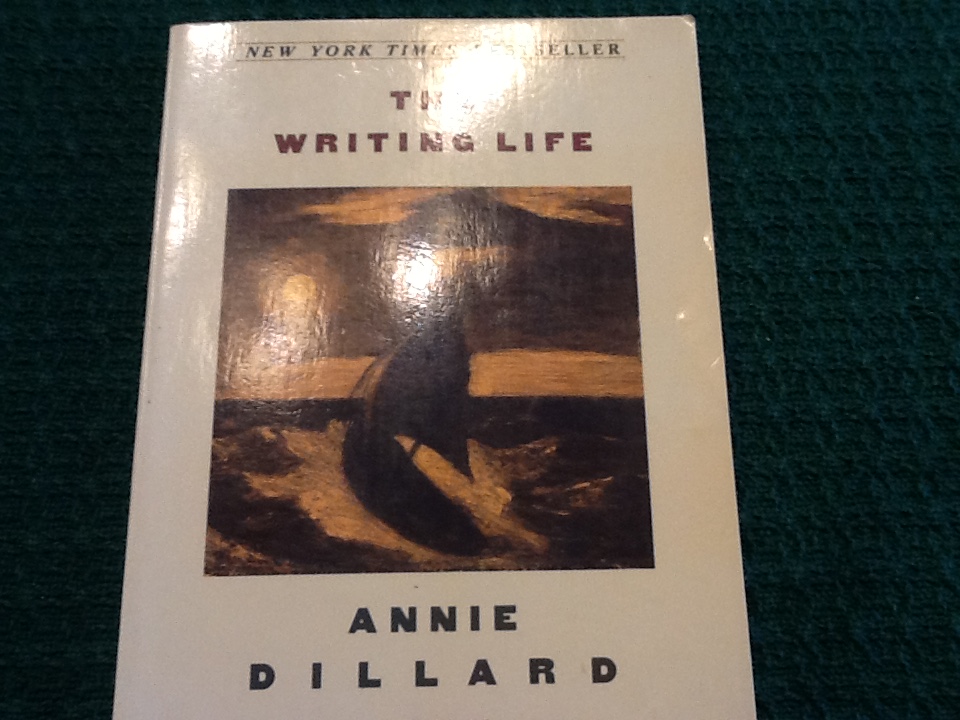
  • That being an author, at least in my experience, is becoming a combination of (1) a writer inspired by her muse, (2) a builder, and (3) a contractor. My muse arrives during the not thinking about writing times, when I have set up my topic and then walked away from my desk to let subconscious juices ebb and flow. The builder begins when I sit down and put my fingers on the keyboard. Annie Dillard described this part of the process with the words, “When you write, you lay out a line of words” (Dillard, 1989, p. 3). I see myself laying down a line of bricks, then building about one line to lay down another, and another. Finally, the contractor is the part of me that time and again shifts from muse to builder and back again, pulling in references as needed, tapping creativity as needed for ideas, and assembling – hopefully – a logical whole.
  • My writing process. I have learned that what works for me, at least with daily blogging, is to decide on topics days or more in advance of the writing. That is the first gift to the muse, allowing her to mine memory and language, emotions and images. Next, I might look for an image, or a poem, or something else that might spark more ideas. My next task is to create a template, inserting the image and a few notes,  then to put it aside and let the muse ruminate until it is time for the builder to lay out the lines. Currently, I have all of the remaining topics chosen and the templates created for each of them for the rest of the Blogging from A to Z Challenge. I draft each of them as far in advance of the deadline as possible.  Afterwards, I return to the piece as often as possible until publication, revising each time.
  • I learned that my memory of details of places and events in the past is better than I realized. I shared in a previous post that one of my favorite ploys  for falling asleep is to revisit in my mind places that I have visited, re-creating favorite scenarios. This has become a part of my writing process as well. I choose a scenario that I will be writing about, walk myself through it as if walking through a guided imagery exercise, and I fall asleep, allowing my faithful muse to do her work.
  • I learned that my writing is honest to the highest degree that I can make it. I might want to add some fictitious gloss to a piece about my reality, but if I stick to the Hemingway decree of writing one, true sentence, my words are clearer, stronger, and richer. As I grow stronger in writing personal narrative, I will venture into fiction.

I know that I am learning much more about myself as a writer than what is revealed in this post, but my muse is still working on it. Thank you for reading!

Reference:

Dillard, A. (1989). The writing life. New York, NY: HarperPerennial.

This post is part of the Blogging from A to Z (2016)  Challenge. Click here. to see all of the blogs in the A to Z Challenge
I is for Ireland

4788105048_7b630711b5_z

Glendalough

From previous posts, some readers may have deduced that I have had a lifelong love affair with Spain. Beginning in high school and college and affirmed beyond a doubt in the year that I spent in Madrid as a 22525844599_f506327a4d_qstudent, Spain has been and forever will be a part of me. It has been my good fortune to return to my love several times during my life, and each time I am there, my heart races with passion as  I feel embraced by the people and their culture. I was told by Spanish friends in the late 60’s that one always said farewell to the fountain of La Cibeles upon leaving Spain, because doing so meant that you would again visit Madrid. Not knowing if this is a folk legend, or something that my friends made up for my benefit, I still dutifully follow the custom each time I visit to ensure my return.  In addition, my hija española (Spanish daughter) cautioned me not to count the lions in the Plaza de la Universidad in her home city of Valladolid, because doing so would mean I would not return to the city. Once again, I will always comply, no matter how hard it is not to count them. Now in my seventies, thinking about returning to my beloved España fills me with morriña, which is the Galician word for homesickness that is used throughout the country.

In the last few years my beloved Spain has competition in terms of my affections. Our family traveled to Ireland about five years ago and never did I think that I could fall in love with a country as quickly as happened there. From the moment we landed and left Dublin for Newgrange and Knowth – ancient burial sites with passage tombs  – I was struck with how comfortable it was to be there. Perhaps it was the Irish expression, Céad míle fáilte, “a thousand welcomes,” which one sees throughout the country. Perhaps it was something akin to Jung’s collective unconscious, as echoes of the Irish ditties my grandmother used to sing to me rang so true in my ears and I sensed a deep connection with the land. Perhaps it was how wrapped in warmth we were when spending the first night in the town of – you guessed it – Navan. We all felt it – the magic and mystery of Eire. The entire trip, filled with castles and cliffs, pubs and pints, was full of good Irish craic (fun, entertainment, and enjoyable conversation). 

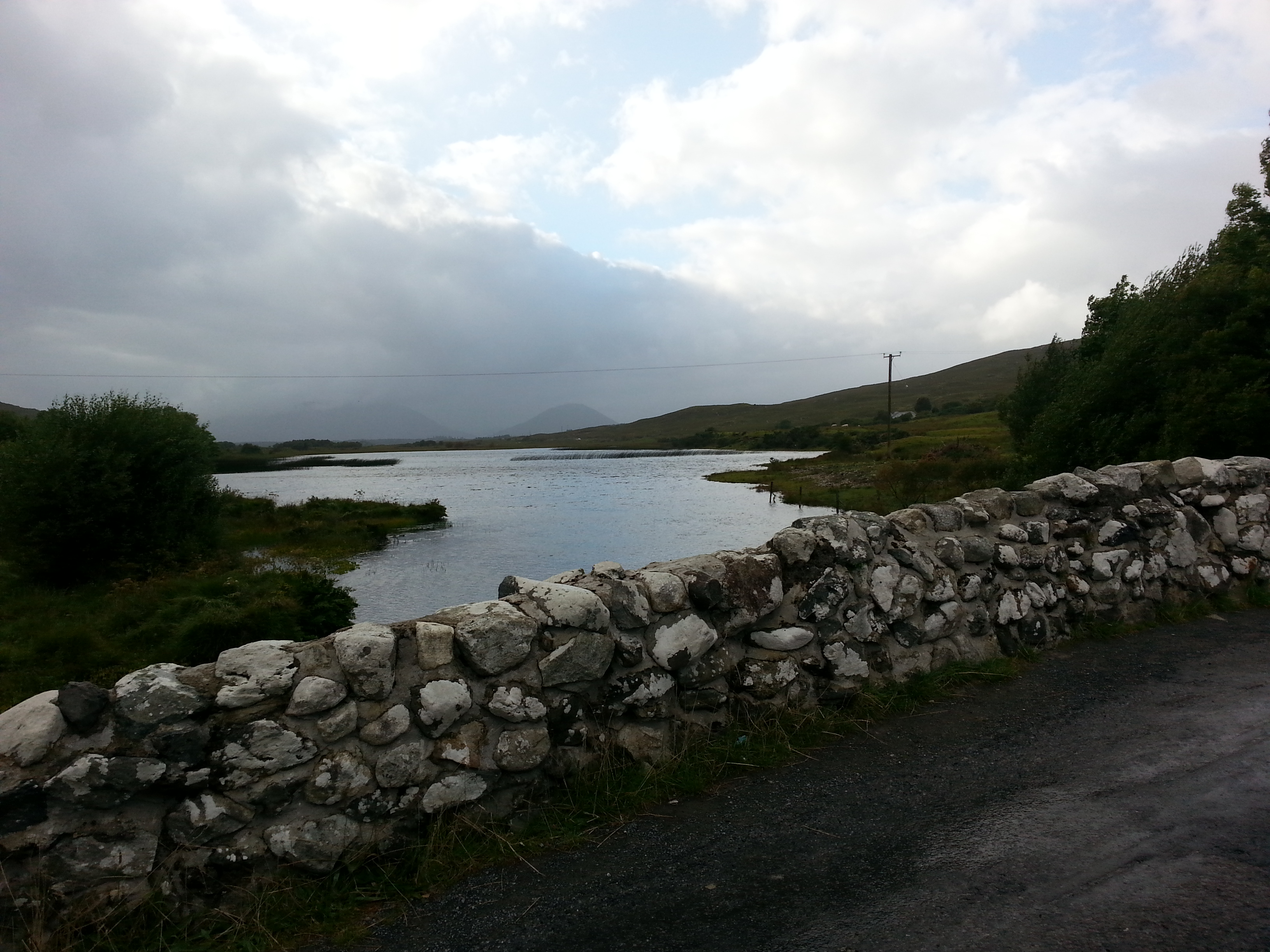
20140829_181724On our second trip, my husband and I stayed in a thatched roof Connemara cottage not far from Quiet Man Bridge, made famous in the film, The Quiet Man. Though we spent each day touring different parts of western Ireland, my favorite part of the day was enjoying the late afternoon sun coming through the window of the cottage as I wrote in my journal with the tang of the peat fire wafting from the parlour. We both had the sense of “coming home” and imagined what it would be like to live in such a setting.

When will we return? Although we have no specific plans, of this I am sure, I WILL return to my newfound love. 

I is for Ireland.

 20140828_113140

Photo ~ Glendalough by Alejandro Escario Mendez on Flicker (https://goo.gl/DKZFhn). (CC BY-NC 2.0).

Photo of Madrid by Nicolas Vigier on Flckr (https://goo.gl/dylgTj). Public Domain.

This post is part of the Blogging from A to Z (2016)  Challenge. Click here. to see all of the blogs in the A to Z Challenge

H is for (her/hers/she)

2178432965_95f4af0dda_z

Recently I have noticed the following parenthetical words cropping up in email signatures:

(she, her, hers)

Being what some might call old school, my immediate question was, “What is this about?” Yet, being new school enough to know that Google owns the secrets to the universe, I popped it into my search box and, voila! Google returned, “About 86,400,000 results in 0.45 seconds.” Go figure!

Quickly wading into the topic, I opened the first hit, a pdf file, to find, Preferred Gender Pronouns: For Faculty (Or, How to Take Important Steps in Becoming a Trans Ally!). The document was a series of questions and answers. The first paragraph explained what a pronoun is and what a gender pronoun is. The document continued with explanations of preferred gender pronouns (PGP), gender-neutral pronouns, and suggestions on how to respect an individual’s preferred gender, and more.

Since I am a woman of a certain age, my first reaction to this new style of personal pronoun use was something like, “Oh my! Life used to be so easy!”  However, I quickly realized that the easy part was for me, and for many other – perhaps most – people. But what about those who spent their lives being referred to with an identity they did not own? And what about, rather than pronouns, they were the recipients of harsh slurs and epithets? Life may be more complicated, but it is, hopefully now, more just.

A few days ago, I read a piece in the Oberlin Review that expresses better than I can what it means to convey honor and respect to others by using preferred gender pronouns (PGP’s). I quote,

“My pronouns are not a preference. They are not something that I would rather have for             dinner or a shade of nail polish I’d have more fun wearing. They are a statement of who I         am and how I would expect to be called. I am not OK with being mis-pronouned; I will not         be comfortable being called he/him/his, or ze/hir/hirs. It is not a preference. It is a                       statement. If you want to be respectful of me as a person, you will call me she/her/hers.             It’s not a matter of what I would rather, it’s a matter of what is right. However, there are             people who do not have strong ties to particular pronouns and may have a preference               between a few that are acceptable; this is a correct use of this term.”

A favorite expression of my husband, which the entire family carries on and lives by,  is,  “A day without learning is a day lost.” As regards gender preferences and identification, sexual preferences and identification, and the gamut of related constructs, I will admit that I have a lot to learn, but I am willing.

References:

Author Unknown,  Preferred Gender Pronouns: For Faculty (Or, How to Take Important Steps in Becoming a Trans Ally!). Retrieved from  http://architect.lgbtcampus.org/training_and_orientation_materials/preferred-gender-pronouns—for-faculty/download.

Hedges-Goettl, N. (April 7, 2016). Pronouns a right, not a preference.  The Oberlin Review.  Retrieved from http://oberlinreview.org/7855/opinions/pronouns-a-right-not-a-preference/.

Photo ~ “Lorena Craig,” by Howard R. Hollem at Flickr (https://goo.gl/3iQ5dO). No known copyright.

This post is part of the Blogging from A to Z (2016)  Challenge. Click here. to see all of the blogs in the A to Z Challenge


G is for “Gammah”

14438311901_b5eb866638_z

It was about the time that our youngest son began to wear “big boys” in place of diapers that I began to look forward to being a grandmother. We had two children and I had always dreamed of having a “houseful of chillen’s,”  a term my Grandma Todd used often when describing my father and his seven siblings and the two or more grandchildren that she raised at any given time. However, due to medical problems, that dream would not be a reality for me. Consequently, two children were all we were allotted. Nevertheless, we were blessed with two wonderful sons.

The vision of having grandchildren was fulfilled when our oldest son was 39 years old and he and our daughter-in-law gifted us with a beautiful grandson.  Since we first saw him at five days old, he has been our treasure. With dark expressive eyes, dimples, and  an enchanting smile, he is delightful.  The first time he said the word, “Gammah,” I melted. Our favorite activity when I visit him is to go for long walks in the red wagon we gave him for his second birthday. We sing songs and we point out to each other all the wonderful things that we see along our walk.

So “G” is for Gammah. In this post, I share with the little tyke that calls me by that moniker all the things I will for him in his life.

Dear GS,

If I were I to write a lyrical narrative about you, I would want to begin by describing all the times that I lulled you to sleep while rocking you gently in my arms. Rocking was always a favorite time with your daddy and your uncle when they were young. I cherished those times as I sang them lullabies. And now, your Grandpa and I are blessed with you, our dear grandson, and we have the joy of recreating anew that lovely ritual.  I wish for you a lifetime of loved ones to hold you gently, lulling within you a sense of peace and well-being.

If I were to continue sharing with you a lyrical narrative, I would share with you all the songs that I sang to you, your father, and his brother. One of them, the song of a delicate white flower that has the power to bless one’s land – Edelweiss. May your land be blessed with people who always display generosity toward their neighbors and understanding of the richness of diversity.

If I were to write more of a lyrical narrative,  I would remind you of what a caring, empathetic soul you are and that you have the ability to influence others in wonderful ways. May you always exercise the Good. And, if I were to continue a lyrical narrative about you, I would commend you for your boundless energy. May you use that energy to create and never to destroy.

If I were to comment on others in a lyrical narrative about you, I would ask you to remember four things, above all. Firstly, your father is a strong, yet sensitive man and you can learn from him how to make the world a better place while also teaching a youngster like you how to be a good human being. Secondly, your mother has given you the gift of caring for others and the ability to always see the positive in others and in the world. I hope that you use those gifts to bring the same happiness to others. Third, your Gampa loves you “the whole world and up to the sky, and more than that!” As you grow, even if it seems he doesn’t always remember, he will never, ever, forget the love he has for you. Finally, your Gammah wishes for you the gifts of stories and songs. Stories to ignite your spirit  and songs to lull you to sleep when you are weary.

G is for Gammah.

Photo by Emiliomtz03 (https://creativecommons.org/licenses/by-nc-nd/2.0/)

This post is part of the Blogging from A to Z (2016)  Challenge. Click here. to see all of the blogs in the A to Z Challenge
F is for … this one is a stretch!

flower.tray

Brainstorming to find a word for “F” while I was walking,  many words came to mind – fit, fitness device, fibromyalgia, fig, Finisterra, and more. Try as I might I could not settle on the “perfect” word until, looking around, I found myself surrounded by – you got it – FLOWERS. Now, not being more than a sometimes gardener nor a floral arranger, I felt that I could not do poetic justice to the subject, so when I returned home to my office, I took up a collection of an early favorite of mine, e.e. cummings. And, da da! The very first poem began with the line, “Thy fingers make early flowers of…” I reproduce the first verse here.  

          Thy fingers make early flowers of
          All things.
          thy hair mostly the hours love
          a smoothness which
          sings, saying
         (though love be a day)
         do not fear, we will go amaying. (cummings, 1959)

I cannot think of cummings without remembering when I first came to read his work. Professor Applebaum was our poetry professor my second year of college. He was one of the most dynamic educators I have had the pleasure of knowing and he inspired in all of us a passion for poetry. I remember him most of all because of another “F” word – funeral. You see, he was in the midst of teaching when we got word of the shooting of President Kennedy. After his death, the entire country attended JFK’s funeral via television. When we returned to class after the national days of mourning, he read a poem with a voice of  such strength and consolation that the young adults in the room were left feeling that, although the world as we knew it had been shattered, our healing could begin. I believe (looking back after 53 years) the poem was the one written by Louis I. Newman for the funeral and I share the first verse below.

A horse dark of hue wears a blanket of black;
Its saddle is empty; its guiding reins slack;
Its footsteps move sidewise; the touch at its head
Is strange to a creature so lovingly bred.

  A phrase that Professor Applebaum used on that occasion in order to share the shock and dismay that we all experienced was, “when the real world seems so unreal.” This phrase comes back to me often as I witness the horrors and atrocities of our present age. The world I grew up in was one where we played late into the night in the neighborhood, a suburb of our nation’s capital, and our parents had no fear of anything hurting us. It was a world where, as a young woman, I traveled alone throughout the U.S., Canada, and Europe with no more than minor concerns for my safety. It was a world where my children were safe in our small town and everyone looked out for them and for each other. It was a world that seemed real, and was real. It was not today’s world.  Flowers and Funerals. cummings

Reference:

cummings, e.e. (1959). 100 Selected Poems. New York, NY: Grove Press.


Newman, Louis I. (1963). The Riderless Horse (November 25th, 1963). Retrieved from https://repository.library.brown.edu/ studio/item/bdr:282655/ .


This post is part of the Blogging from A to Z (2016)  Challenge. Click here. to see all of the blogs in the A to Z Challenge

Photo by Annie Spratt on http://www.unsplash.com (https://goo.gl/qS62nD)

E is for Effort

writer“All you have to do is write one true sentence. Write the truest sentence that you know.” 

Ernest Hemingway

E is for effort. Keeping up with the Blogging from A to Z April Challenge requires an effort for someone who is a “sometimes” writer like me. Yes, I have published a book and numerous academic and non-academic articles. However, I have never developed the discipline of a true writer. A true writer is a person who – like Hemingway for example – wrote nearly every day of his adult life. He would keep a tally of his daily word count, and “bank” words ahead so he would not feel badly if he took a day off for fishing or another diversion. I am not a true writer. True writing takes effort and persistence.

Another of Hemingway’s writing habits was to write standing up, using a bookcase to hold his writing paper and pencil or typewriter. I do not write standing up; although I am considering doing so. Regarding sitting and writing, I paraphrase an author who once spoke to a group of my gifted students at a young writers’ conference. He shared that in order to call oneself a writer one has to develop daily and sustained contact between one’s behind and the chair.  This month I am exercising that advice. Even though I have written much in my life, I have never practiced the discipline of sitting and writing day by day. It takes effort.

The pressure of cranking out a blog post each day will be my training in preparation for becoming a semi-true writer. Twenty-six blog posts, one to be posted each day except Sundays. The act of setting a goal and making it public increases the commitment, thus increasing the chance of success.  “E” is for Effort.

This post is part of the Blogging from A to Z (2016)  Challenge. Click here. to see all of the blogs in the A to Z Challenge

Photo by Dustin Lee on http://www.unsplash.com (https://goo.gl/b1Wb3B).

D is for Distinction

13325984_09448d8f5a_z

A few days ago, I returned to a book that I read a number of years ago when I was involved in research regarding gifted females. The book, Gifts of Age: Portraits and Essays of 32 Remarkable Women, explores the creative contributions of well-known women; for example, Julia Child and Joan Baez, as well as lesser-known yet still outstanding women. The individuals in the book are creators, givers, healers, and seers. The stories of their lives are lessons to us regarding how to grow and become better selves.

It was my good fortune during my life as a doctoral student to read and to assist in the analysis of interviews of eminent Canadian women. Later, as an academic, I interviewed a number of eminent American women. Perusing the pages of Gifts of Age and remembering our interviews caused me to reflect on the women of distinction that I have known at different stages in my life and the gifts that I have received from them. I invite my readers to do likewise. Because some are still living and because this month of producing a blog each day does not allow me the time to obtain permission from each to publish names, most shall remain unnamed for now.

  • I remember the gift of reading that my mother, Evelyn Freeman Todd, gave me. It started me on the road to a life of learning. Who gave you the gift of reading?
  • Another woman of distinction my life was my kindergarten teacher, Mrs. Poole, who told my mother that I, “would go far.” Looking back, I realize that she gave me responsibilities that normally a kindergartener could not take on.
  • Many, many other teachers stand out in my memory as well. In particular, I remember my high school Spanish teacher, who gifted me with the passion for learning languages; and my doctoral advisor, who passed on to me the passion of pursuing life as an academic. What are you passionate about and who led you to that passion?
  • The list of women of distinction in my life is not easily exhausted, as there are so many women from throughout my life for whom I feel gratitude. However, I cannot close this reflection without sharing the gift of my mentor, Annemarie Roeper, who taught me so many lessons about growing old gifted. Is there a gifted elder whose lessons you follow?

Reference:

Painter, C. (1985).  Gifts of Age: Portraits and Essays of 32 Remarkable Women. San Francisco, CA: Chronicle Books.

This post is part of the Blogging from A to Z (2016)  Challenge. Click here. to see all of the blogs in the A to Z Challenge. 

*Photo: Women, by Candace on Flicker ~ https://goo.gl/eljgsy. (CC BY-NC-ND 2.0).

C is for Clothe

hannah.morgan

Clothe: to dress (someone) in a particular type of clothing

Yesterday I put on one of my favorite pieces of clothing, an aqua-colored fleece, quarter-zip, mock turtleneck. The logo on it is the name of a company that makes outdoor clothing for the young and active. While labels and logos are items that have never impressed me much since I clothe myself for softness and comfort, it occurred to me that some might interpret my clothing as not age appropriate. While I am beyond  worrying about such judgments at my age and station in life, I did pause and begin to muse, asking myself, “How does one clothe oneself for elderhood?” “C” is for (to) clothe.

The quote on the right begins to answer my question.  I am clothed as the person I have become.  More importantly, I may choose how I want to clothe the rest of my elderhood.  As I have thought and shared with others many times, we are – in the opinion of the existentialist philosophers – the sum total of the choices we have made up to the present.  

Consequently, I have become a gifted elder who has made good choices and bad choices. I am an individual who struggled with the “g” word (gifted) throughout most of her life because she chose self-doubt over owning her reality. I have become who I am because I am a spiritual being who believes and lives the belief that a prime being, a creator, put the universe into motion and engendered a force that we call Love. It is our mission to be the continuation of that force. I have become who I am because 42 years ago I married my spouse and we, together, have raised two amazing sons. I have become who I am because I am an educator who, when she did it right, enabled and empowered her students to self-actualize. 

But what shall I become? Or, better stated, what do I choose to become as a gifted elder?

  • I choose to be a truth-sayer,  sharing the important truths with my loved ones now, when they need saying.
  • I choose to continue to be open to the newness of life and not to allow the pain and difficulties of aging to tint its beauty.
  • I choose to continue to create, to instill in others a sense of hope for this age beyond adulthood.
  • I choose to relinquish the spotlight to the younger. I had my days in the sun and what I do now, I do with humble spirit, as an elder.
  • I choose to clothe myself in gifted elderhood, to be a change agent in my own life and not to passively allow my life to happen to me.

What do you choose to become?

This post is part of the Blogging from A to Z (2016)  Challenge. Click here. to see all of the blogs in the A to Z Challenge. 

Reference:

Merriam-Webster Online Dictionary. http://www.merriam-webster.com

* Photo by Hannah Morgan on Unsplash (https://goo.gl/7cMY9V)                                         **Quote by unknown author (https://goo.gl/AmVUFW).

“B” is for Bréa

paris.

“B” is for (Rue) Bréa

When a friend or relative begins to show problems with memory, often friends and loved ones gather photos into an album, write memories on slips of paper and place them in a memory box, or perform similar kindnesses in an effort to assist the loved one in remembering significant people or places from the past. One of the pleasures of growing old with one’s memory reasonably intact is the art of gathering one’s memories, creating gilded and bejewelled mental memory boxes for them; and having the ability to open the boxes, bringing the remembrances to mind again and again. Additionally, for one with sleep difficulties like me, the activity of gathering and reminiscing is a pleasant way of inducing sleep, a self-guided imagery exercise.

In creating one of my memory boxes, I have dwelt recently on one of my favorite cities. It has been nearly fifty years since I first set eyes on Paris. Arriving at the Gare du Nord on the boat train from Le Havre (Does anyone really travel to Europe by ship anymore?), I caught a taxi to meet a friend at the Alliance Française, where she would study for the year. I planned to spend a week in Paris before traveling on to Madrid for my own studies. I was overwhelmed at seeing the city for the first time after years of dreaming of that day; and I believe the taxi driver thought me a bit odd, since all I could say as we drove down the Champs Elysées was, “I cannot believe it! I cannot believe it!”  En français – in French, of course!

     Since my friend had housing arranged for the year in a student dormitory and I had not made lodging plans, one of her roommates suggested a small pension hotel nearby, on Rue Bréa. And there began my love affair with the City of Light. One of my fondest memories are of the sweet landlady who brought me a tray each morning with my breakfast – warm croissants, with fresh butter, marmalade, and steaming café au lait. Oh, how I relished the morning light streaming in the window – is there any light as remarkable as that of Paris – and the luxury of breakfast in bed!

     Later, walking down Rue Bréa to Rue Vavin, and finding oneself just a few steps from the Luxembourg Gardens, I could meander through the park. Or, if I chose, I could turn onto the Rue d’Assas and stroll along to Rue de Fleurus, following  Hemmingway’s route on his visits to the home of Gertrude Stein. In A Moveable Feast, he wrote of a girl he observed in a café, “I’ve seen you beauty, and you belong to me now…and all of Paris belongs to me.” In that moment, and in these memories, Paris belongs to me as well.

     B is for Bréa. I remember the charcuterie across the quiet street as I looked out the window of my room in the pension and I can re-create the sound of the heavier traffic on the Boulevard Raspail. I remember as well the short walk to the Metro that I took to meet my friend. We would walk the streets until we were hungry, and then buy a baguette of French bread, some cheese and wine, and sit to have a picnic along a quay, gazing across the Seine up at the Eiffel Tower. I remember one evening going to Montmartre with some Germans who were studying at the Alliance. We spent the evening on the steps of the gleaming white Sacré-Coeur basilica,  singing American folk songs with young people from all over the world, sounds of guitars wafting into the night. 

Yes. Paris belonged to me in those days and I possess it once again in this remembrance.  

Mental memory boxes, filled and bejewelled. Paris – Rue Bréa. B is for Bréa.

Reference:

Hemingway, E. (1964). A Moveable Feast. New York, NY: Charles Scribners Sons.

This post is part of the Blogging from A to Z (2016)  Challenge. Click here. to see all of the blogs in the A to Z Challenge. 

* Photo by Ivanna Salgado ~ https://goo.gl/VNXefO